“Walking, We Ask Questions”
The Other Campaign in Spanish Harlem
By RJ Maccani
Inspired by the Black Panther Party and Chicago’s Young Lords, the New
York Young Lords Party launched a surprising first campaign in the summer
of 1969. Called “The Garbage Offensive,” it was designed to force the New
York City Sanitation Department to make more frequent pick-ups in East
Harlem (often referred to as Spanish Harlem or simply “El Barrio”). The
Garbage Offensive won the trust and respect of their neighbors and
garnered the Young Lords Party local and national visibility. Although
inspired by the Black Panther’s community-based programs, the New York
Young Lords didn’t expect to be picking up garbage when they discussed
forming an organization to improve living conditions in their primarily
Puerto Rican neighborhood. Before launching their first campaign, however,
the Young Lords went to their neighbors to find out what they most wanted
to see changed. The Garbage Offensive was the fruit of this dialogue, the
will of the people. Proudly inclusive of their Latino and Black neighbors,
the New York Young Lords’ center of gravity was Nuyorican (Puerto Rican
New Yorkers), and the independence of their homeland, Puerto Rico, a
central concern.
More than 35 years later, El Barrio is home to more than 100,000 people,
half of whom are Latino. New waves of immigrants from around the world and
white gentrifiers have changed the face of El Barrio. Spanish is still its
most spoken foreign language, followed now by Chinese and other Asian
languages, Arabic, and several African languages. Whereas the Latino face
of El Barrio had been primarily the Nuyorican with citizenship, today it
is increasingly immigrants from Mexico and elsewhere, many of whom lack
U.S. citizenship (or any legal status for that matter), who make up its
Spanish-speaking population. Nearly 40 percent of El Barrio’s residents
live below the poverty line. It is here, in this place and at this time
that the Movement for Justice in El Barrio (MJB) is emerging. The radical
reference point and inspiration is no longer the Black Panther Party but
Mexico’s Zapatistas and the national initiative they form a part of, the
Other Campaign.
Movement for Justice in El Barrio
MJB was born almost two years ago when residents of El Barrio, some of
them congregants of Saint Cecilia’s Church on East 106th Street, began to
organize against problems with their landlords. To support them in
addressing their grievances, the church hired Juan Haro, a founding member
of AZUL (Amanecer Zapatista Unidos en la Lucha), a Mexican immigrant
organization inspired by and in solidarity with the Zapatistas. Haro
worked with the residents, they successfully organized against the
landlords to win their demands, and the church ended its involvement.
With residents in five buildings organized, Haro and the founding members
decided to form MJB as an immigrant-led, community-based organization that
would fight for social justice and against all forms of oppression in El
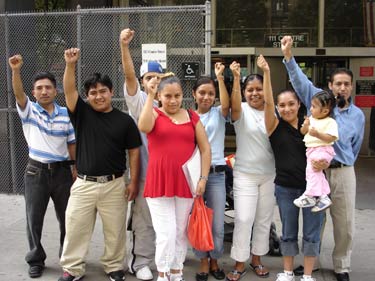
Barrio. Over the past two years, MJB has employed media tours, court
actions, protests, and direct actions against landlords, mortgage lenders,
and city institutions to challenge the unjust housing system in El Barrio.
Through this work, MJB has grown to 180 members in 16 buildings. In August
of 2005, MJB began studying locally based social justice movements from
around the world in order to better understand their own struggle in its
global and historical context. The Zapatistas and the Other Campaign were
among the movements studied. Through this process they decided to adhere
to the Zapatistas’ Sixth Declaration of the Lacandon Jungle and, since a
majority of their membership is Mexican, MJB decided to join the Other
Campaign as well. And they did not do so quietly…
Since joining the Other Campaign, MJB has been reported on extensively and
favorably—in New York City—on television and in print, in Spanish and
English—for its continued work against gentrification in El Barrio. They
have created a video, “Message to the Zapatistas”, that is to be brought
down to the border at Juarez City for the meetings of the Other Campaign
with Delegate Zero (Zapatista spokesperson Subcomandante Marcos). MJB has
organized a protest at the Mexican Consulate in solidarity with the people
of Atenco. At the invitation of another adherent group to the Sixth
Declaration, Latinos Unidos en Acción (Latinos United in Action), MJB gave
a presentation on Zapatismo in New Haven, Connecticut at a community forum
for immigrants of color. They made a second presentation in Hartford at
the invitation of another group, Latinos Contra la Guerra (Latinos Against
the War).
In July of this year MJB launched its latest initiative, a comprehensive
community consultation process called “La Consulta del Barrio.” MJB is
ready to grow and, as you will see, the Consulta is very inspired by the
Other Campaign. Through town hall meetings, community dialogues, street
outreach, door knocking, house meetings, and a community-wide vote, MJB’s
members have consulted their neighbors in El Barrio for direction and to
decide which problem, in addition to gentrification, they will begin
organizing around. I attended their first public forum held at St.
Cecelia’s Church where, less than two years before, the complaints of a
few disgruntled tenants helped to sow the seeds of MJB…
La Consulta del Barrio
On July 23rd, residents of El Barrio trickled in to the sparse basement of
St. Cecilia’s for the first public meeting of the Consulta. They received
bottled water, a photocopied El Diario NY article about MJB, and copies of
the Zapatistas’ Sixth Declaration to read while waiting for the forum to
begin. Young children were invited to draw and play. With half of the
room’s 60 folding chairs filled, the organizers decided it was time to get
things started.
Rotating between male and female members, MJB introduced its organization
and the reasons for the Consulta. One member summed up the importance of
the Consulta with humility, “We are but one organization. How can we make
decisions for El Barrio? We’ve learned that we can fight together and that
the people themselves can fight without having to be under one leader.”
They capped off the introduction by explaining a bit about who the
Zapatistas are and why they, MJB, are adherents to the Zapatistas’ Sixth
Declaration. Before moving into a larger conversation about problems in El
Barrio, they showed their video, “Message for the Zapatistas.”
Featuring snippets from interviews with over a dozen of MJB’s members,
“Message…” is a powerful expression of their perspective, politics, and
direction as Mexican immigrants fighting for justice “on the other side.”
Moving through different themes and capturing equally men’s and women’s
voices, the video captures their views on why they left Mexico, what they
think of Mexico’s political parties, their struggles in NYC with housing,
work, immigration, and the Mexican consulate, their commitment to the
equal rights of women and queer folks, and their reasons for joining the
Other Campaign. The video is a scathing indictment of the Mexican
political system, neoliberal globalization, and oppression in the US.
Describing the Other Campaign as “the magic touch to find another way,” an
MJB member explained that it inspired them “to fight in NYC and to claim
justice now” while building towards a greater goal: “to free Mexico and
return.”
This was as clear and forward an introduction as I’ve ever seen and it led
into a group discussion of MJB’s next steps. Through an internal
consultation of its membership, MJB had generated a list of the eight
biggest problems in El Barrio other than gentrification: the sexual
harassment of waitresses, mistreatment in the hospitals, bad service at
the Mexican Consulate, police abuse, jobs paying less than the state
minimum wage ($6.75 per hour), the high cost of public transportation, the
proposed immigration laws, and the high cost of sending money back home
($4-5 for a $100 remittance) as well as the mistreatment they receive from
the intermediary companies.
Nearly everyone in attendance spoke up regarding the problems in El Barrio
and the possibility of organizing to make change. Some people thought that
MJB should expand its organizing beyond the borders of East Harlem and
others thought that they should not pick just one problem but, rather,
attempt to fight all these problems simultaneously. At the conclusion of
the forum each attendee filled out a ballot with their name, phone number,
and address, and circled the top three problems they would like to see
addressed by MJB. Before leaving, attendees took stacks of flyers to hand
out to their friends, family, and neighbors, providing information on the
location and hours of the public voting booths MJB was setting up in El
Barrio as part of the Consulta. And for people who were not able to attend
a forum or go to the voting booths, the flyers included MJB’s phone number
for people to call, leave their contact information, and vote by phone.
Stage Two…
The idea of the Consulta is not just to generate consciousness and
symbolic participation (voting) in the community but also rather to
inspire more people to become active in the struggle. After a month of
activity, the first stage of the Consulta del Barrio is complete with 782
immigrants in El Barrio having cast votes. Just announced, the three
problems in El Barrio that received the most votes are 1) jobs that pay
less than minimum wage; 2) the proposed immigration laws; and 3) bad
services at the Mexican Consulate.
Stage two of the Consulta del Barrio is set to begin. Community dialogues
will be held for each of these three problems, starting with the problem
of bad services at the Mexican Consulate (including having to wait in line
overnight just to receive service). The second forum will be about jobs
paying less than minimum wage and the third on immigration laws. Based on
the level of interest in the community at each forum, MJB will decide
which problem, in addition to gentrification, they will prioritize.
The Struggle is Listening
Amidst the din caused by electoral fraud, it has been harder to hear in
these past few months the scream for justice coming from Mexico’s Other
Campaign. There are two Zapatista sayings that are well worth remembering
in these times. They are, “We walk slowly because we are going very far”
and “Walking, we ask questions.” In less than a year since the Other
Campaign was announced from the mountains of Southeast Mexico, the Other
Campaign has walked from the Zapatista communities in Chiapas, through the
32 territories of Mexico, and across the border all the way up to East
Harlem.
The Other Campaign grows not by captivating the audience with flashy
advertisements but, rather, through listening and walking. Like the Young
Lords of Spanish Harlem’s past, the Movement for Justice in El Barrio is
dialoguing with its neighbors today and preparing for surprising results
tomorrow. Whether fighting for the freedom of its political prisoners in
Mexico or halting gentrification in New York City’s El Barrio, the Other
Campaign continues to walk and listen and grow.
RJ Maccani reported for the Other Journalism on the activities of the
Other Campaign in the state of Oaxaca as a member of the “Ricardo Flores
Magón Brigade.” He lives in Brooklyn where he organizes with the NYC
Childcare Collective and publishes the blog Zapagringo.
MJB can be contacted directly by writing to
movimientoporjusticiadelbarrio[at]yahoo.com