Monday, May 29, 2006

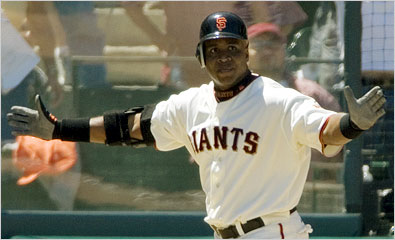
Barry Bonds hits # 715

Anyone who knows me, knows im a big baseball fan. Not only a big baseball fan, but a big San Francisco Giants fan. My cousin took my to my first Giants game at Candlestick Park (their old stadium) when I was seven years old. We sat in the cheap seats far away from home plate, but i remember it being a magical day, even if i couldnt really tell what was happening on the field. From that day on i followed the team as best i could, often staying up way past bedtime to listen to the late scores on the radio (since i lived in New York and the night games would not end until one in the morning.)

The Giants are one of these teams that never quite make it to the top. They have yet to win a World Series Championship since they moved from New York to San Francisco in 1958, although they came close a few years ago in 2002. They were playing the Angels in the World Series and were a few outs away from winning the whole thing when they let it all slip away once again. They lost game 6 in the late innings after building a comfortable lead, and then proceeded to lose game 7. I listened to that game six on the radio coming back from a big anti-war demo in DC, packed in a van with about 10 other students who could care less about baseball. At the time i was happier that the demo has turned out so well and so the loss was less hard on me.

Fast forward to 2006. The Giants are not winning much of anything for a long time. Their best player for the past 13 years, Barry Bonds, is hobbling around and is a few mis-steps away from retirement. The team has been surrounded by controversy after Bonds has been implicated in the steriod scandal that has rocked baseball over the past two years.

Kind of like that best friend who uses you to get in with the popular kids and then dumps you when he or she has gotten in good, Major League Baseball has turned on Barry Bonds this past year in an effort to cover up its own shortcomings. Barry Bonds was one of those players who rescued baseball in the mid 1990s. After a labor strike ended the 1994 season, baseball started losing serious ground to the other major sports like basketball and football (even hockey if you can imagine that). It was not until the "big home run sluggers" like Mark McGwire, Sammy Sosa, and Barry Bonds started chasing baseballs home run records that the fans started filling the seats again. Right around that time, baseball designed a series of crazy cartoon commercials featuring players like the ones mentioned above looking like muscle-packed super heroes. Now of course they say they "want to come down hard" on illegal substance users. They can barely hide their contempt and racist rhetoric on the nightly news when discussing Barry Bonds. How quickly friends forget.

Well Barry hit historic home run #715 yesterday afternoon against the Colorado Rockies passing the legendary Babe Ruth, a player who never had to face African American pitchers due to segration in professional baseball. It was nice to see it happen at San Francisco's home ballpark in front of all of his hometown fans. Barry deserved that after all he has been through.

This will probably be the last Giants highlight for me for several years to come. Barry is going to retire, probably after this season, and the Giants are not going to keep trying to compete in the "richest owner takes all" sweepstakes that has become major league baseball. I will be rooting for him the rest of the way... perhaps this fall on my way back from another anti-war demo in DC I will be able to turn on the radio and listen to Barry hittin' one out of the ballpark , just for old times sake.

Saturday, May 27, 2006


Washington's Wars and Occupations: Month in Review #13

By Max Elbaum, War Times/Tiempo de Guerras
www.war-times.org


ROVE & BUSH WANT "GAME-CHANGERS"

Karl Rove started talking about "game changers" during a speech at the
conservative American Enterprise Institute May 15. George Bush's top political hatchet
man is looking for something that can "push the political debate in new and
more congenial directions."

And no wonder.

Bush's approval rating is at an all-time low, with one poll even putting it below
30%. Public confidence in Bush's handling of Iraq, the economy - even the "war
on terror" which was once his unbeatable trump card - has all but collapsed.
Harsh criticism of the President is now coming from conservative pundits, retired
generals, elite opinion-makers and even Bush's increasingly restive and divided
grassroots base.

And most recently the administration has been challenged by millions-strong actions
for immigrant rights. Huge marches, rallies and boycotts have not only transformed
the terms of the country's immigration debate: they have reminded everyone of the
power of mass action and the exploding importance of the country's Latino
populations.

This changed political terrain provides greater opportunities for denting the
right-wing's hold on power and policy than at any time since 9/11.

But there are grave dangers as well. Bush and Rove have already shown that their
"game-changer" on immigration is sending the National Guard to the U.S.-Mexico
border and building a fence. And they keep sending ominous warnings that their
gamble-everything game-changer is an attack - possibly with nuclear weapons - on Iran.

IMMIGRATION "REFORM": CALL OUT THE TROOPS!

Inside the Washington Beltway, the upsurge for immigrant rights has translated into
some unexpected Senate votes against the most repressive anti-immigrant measures.
It is also causing tremendous anxiety among Republican leaders fearful of alienating
the entire Latino population for decades to come.

But the nativist/racist right is still pressing its agenda of demonization, deportation
and militarization. Bush's May 15 speech, as even the New York Times pointed out,
"swiveled in the direction of those who see immigration, with delusional clarity,
as entirely a problem of barricades and bad guys." The Senate meanwhile is
adding repressive amendments (such as authorizing a border fence) to its already
bad Hagel-Martinez "compromise" bill. Any further compromise with the
terrible measure the House passed earlier will only make things worse. The Center
for Human Rights and Constitutional Law rightly points out that Congress is actually
considering immigration policy regression, not reform.

In response, grassroots immigrant rights groups - especially in Latino communities
- and allies are building on the momentum of the huge April and May 1 protests to
carry on the fight for fairness and legalization for all. To follow the battle in
Congress and find information about mass actions, go the websites of the National
Network for Immigrant and Refugee Rights - http://www.nnirr.org/ - and the Rights
Working Group: http://www.rightsworkinggroup.org/

EXECUTIVE POWER-GRAB

The administration's attitude toward civil liberties is equally backward. Tapping
international calls without obtaining a warrant is now old news. The latest revelation
is that the National Security Agency is assembling the largest database in history
- a record of every call made from every phone in the U.S. General Michael Hayden
- who ran the NSA secret domestic eavesdropping program until last year - is now
nominated to head the CIA. Most Democrats as well as Republicans are expected to
vote for his confirmation.

The administration's brazen defiance of the law and the Constitution provision against
"unlawful search and seizures" (the Fourth Amendment) is no isolated incident.
As the Boston Globe reported April 30, "President Bush has quietly claimed
the authority to disobey more than 750 laws enacted since he took office, asserting
that he has the power to set aside any statute passed by Congress when it conflicts
with his interpretation of the Constitution."

Things have gotten so far out of hand that it is almost impossible to even investigate
- much less stop and punish - Bush administration illegalities. After the NSA's
warrantless spying program was first exposed, the Justice Department launched a
probe to see if it was legal or not. That investigation has now been closed - because
the lawyers assigned to conduct it were denied security clearances necessary to
get any information about the program!

IRAQ: "DREAD AND HOPELESSNESS"

While Bush keeps talking about Iraq "turning points" and media coverage
focuses on the newly formed "permanent government," life for ordinary
Iraqis gets more difficult every day. A May 18 story from Baghdad in the San Francisco
Chronicle opens with the line: "Dread and hopelessness have taken hold in this
city."

The story goes on from there:

"Since the bombing Feb. 22 of the Shiite Askariya Shrine in Samarra, Baghdad
has descended into a maelstrom of killing that shows little sign of abating. Most
of the victims have been taken from their homes and executed, their bodies dumped
in residential streets and alleys. At least 3,500 Iraqis have been killed this year,
according to official statistics. In April alone, according to the Health Ministry,
762 people - primarily civilians - were killed in Baghdad. The previous month, the
Baghdad morgue received 1,294 bodies, more than double the 596 received in March
2005... As many as 100,000 people have fled their homes in Baghdad..."

The presence of U.S. troops, rather than staunching the bloodshed, only fans the
flames. The latest proof is a Pentagon probe into the death of Iraqi civilians last
November in the Iraqi city of Haditha. According to Rep. John Murtha, the report
will show that U.S. Marines "killed innocent civilians in cold blood."
NBC news reports that military officials have confirmed that the Marine Corps' own
evidence appears to show Murtha is right. This kind of news disappears from the
U.S. media and public consciousness in a flash. In Iraq, incidents like this - which
happen frequently, if not usually on this scale - are not forgotten, and fuel the
ever-rising anger at U.S. occupation.

TARGETING IRAN & BACKING ISRAELI UNILATERALISM

U.S. threats to attack Iran are rapidly becoming a top-priority international concern.
Respected analyst Aijaz Ahmed, writing in India's Frontline magazine (May 6-19),
says: "The possibility of a nuclear strike against Iran has now entered mainstream
political discourse in the U.S. This needs to be seen in the perspective of U.S.
determination to attack Iran but the virtual impossibility of achieving all its
objectives through non-nuclear means, and the predominance, at the highest levels
of the Bush administration, of men who believe that problems of a global war and
the consequent overstretch can and should be resolved by deploying "mini-nukes"
- not retreat, but escalation to a higher level."

While threatening Iran, Washington stands by quietly as nuclear-armed Israel announces
plans to unilaterally "settle" the Israel-Palestine conflict. "Prime
Minister Ehud Olmert won formal approval for his coalition government today, and
he told Parliament he was prepared to set Israel's boundaries during its four-year
term," reported the New York Times May 4. "'The borders of Israel that
will be formed in the coming years will be significantly different from the territories
under Israel's control today', Olmert said. He has not specified the exact borders,
but he has said that Israel's West Bank separation barrier will form the basis."

Israel's plans - like its current occupation - are in much clearer violation of
U.N. resolutions and international law than anything Iran is doing. But Washington
backs Israel instead of uttering even a word of protest.

REPRESSION IN EGYPT, BOMBING CIVILIANS IN AFGHANISTAN

Likewise, Washington - which is supposedly "promoting democracy" - is
quiet when the Egyptian government violently cracks down on citizens demanding judicial
independence. Reuters reported that thousands of riot police deployed in central
Cairo May 18 and that plainclothes security men beat and arrested hundreds.

In Afghanistan, one of the deadliest U.S. air strikes since the 2001 invasion killed
at least 16 civilians it the village of Azizi in Kandahar province May 21. Outcry
from the populace pressed President Hamid Karzai to order an investigation into
the bombing and to express ''concern at the coalition forces' decision to bomb civilian
areas.'' The head of the Afghan Independent Human Rights Commission in Kandahar,
Abdul Qadar Noorzai, said villagers coming in to see him reported 20 to 25 civilians
killed and 30 to 35 wounded. U.S. authorities defended the decision to bomb the
village on the grounds that Taliban fighters were allegedly hiding there.

CLOSE GUANTANAMO! U.S. IMAGE IN FREE-FALL

The United Nations panel that monitors compliance with the world's anti-torture
treaty became the latest prestigious body to call for the U.S. to close its prison
at Guantanamo Bay, Cuba, and avoid using secret detention facilities May 19. The
call came on the heels of the same demand from Britain's Attorney General, Lord
Goldsmith, who declared that Guantanamo had "become a symbol of injustice"
and that its existence was "unacceptable". A few days earlier, on May
3, Amnesty International declared that torture and inhumane treatment ere "widespread"
in U.S.-run detention centers in Afghanistan, Iraq, Cuba and elsewhere. The Amnesty
official report noted that Washington has sought to blame abuses on "aberrant
soldiers and lack of oversight," much ill-treatment actually stemmed from officially
sanctioned interrogation procedures and techniques.

With voices like these condemning Bush administration actions, Washington is more
globally isolated than ever. Roger Cohen writing in the International Herald Tribune
May 17 described the dilemma facing Karen Hughes - Bush's "Undersecretary of
State for Public Diplomacy" - whose job is to promote a positive image for
the U.S.:

"She gives the impression of a woman racing against the tide. The tide in question
is anti-Americanism, perhaps the fastest-growing force in the world today.... The
image of the U.S. is in something close to a free fall....somewhere along the way,
most acutely in the past few years, people in the world got tired. They got tired
of America's insatiable need for an enemy.... alarmed at the American fear that
appeared to fire American aggression; and disdainful of the distance between
declarations and deeds. In short they stopped buying the American narrative.

"It's hard to seduce people at charming airports when they're getting fingerprinted.
It's hard to sell 'a message of life and opportunity' when kids are being killed
every day in Iraq. It's hard to convey a message of openness when American embassies
are being transformed into fortresses. It's hard to attract the world's best students
when visas get held up."


Friday, May 26, 2006

South Central Farm Blockades!

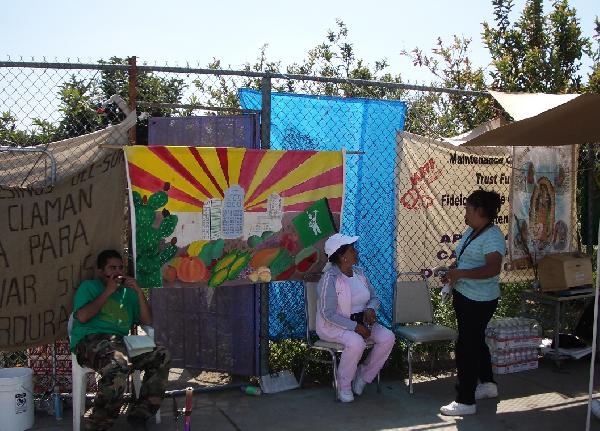
For those not familiar with the ongoing struggle to save the largest urban farm in the US, you can listen to a radio interview here. Also check out LA Indymedia and the South Central Farmers website for the most up to date info, but the latest news is that:

Hundreds of people gathered at the South Central Farm last Wednesday night to defend the farmers from eviction and their farm from destruction. A vigil surrounding the farm was held and later in the evening there was Hip Hop, Son Jarocho and dancing. Supporters continue to arrive every day and the encampment is growing. With the stay on evictions lifted on Tuesday, evictions could come at any moment. For now it seems that the large numbers of people coming to the farm may be the only thing preventing the evictions. The sheriffs to date have not received notice to proceed and there has been no sign of increased police presence near the farm.

People have been camping outside the farm for months. It is a similar to the Six Nations struggle up in Canada. Both are primarily indigenous spaces of land and sustenance housed within settler states; both are resisting; both have anarchists and socialists helping out with the blockades. For a first-hand account of whats happening on the ground right now, Clamor magazine just posted this on their website.

Iraq Veterans Against the War
An Interview w/ Jose Vasquez

Even if you dont care much for public opinion polls, you get the sense that over the past 6-12 months the general US population has come to terms with the fact that the government has been lying to them for a long time, specifically about the reasons why we are in Iraq. Significantly the anti-war movement has not had as much of a visible presence, though United for Peace & Justice [UFPJ] did pull off a successful mobilization here in New York on April 29th. One thing the anti-war movement has made great headway on, which has gone a little under the "movement radar" due to the lack of street demonstrations, has been the support for the various Veterans groups and Counter-Recruitment organizing efforts which are literally taking place in every part of the country.

One of the most inspiring and important of these anti-war veteran groups is IVAW (Iraq Veterans Against the War) which was founded just over a year ago. The group is small (approx 50 members across the country) but it is growing fast and includes some amazing young organizers who are going to be around for a long time. One of these organizers is the president of the New York chapter, Jose Vasquez, who i had the pleasure of working with on the Sir! No Sir! film over the past few months. Francesca Fiorentini, editor of the War Resisters League magazine (as well as Left Turn magazine), and Steve Theberge who works on youth & counter-recruitment also for the WRL did an extended interview with Jose which gives you a great inside look at what made a life-time soldier turn into an anti-war organizer. Also if you are looking to support IVAW - check out their merchandise page here

Thursday, May 25, 2006

Anti-Racism for Global Justice
An Interview with the Catalyst Project

Just came across this interesting interview with some of our friends who
work with the Catalyst Project out on the (left) coast. The Catalyst Project
is a center for political education based in the SF Bay Area. It was founded
in 2000 as a collaboration between white anti-racists from the Civil Rights
and Black Power movements of the 60’s and 70’s and a younger generation of
white activist from primarily the global justice and anti-war movements.
In the past five years Catalyst has lead over 100 workshops with over 4500
participants. Clare Bayard and Chris Crass are interviewed here after a
workshop they ran back in January. Clare was also part of a forum I edited
last spring, on "anti-racist organizing strategies" for Left Turn #16.


Hot new counter-recruitment flash animation

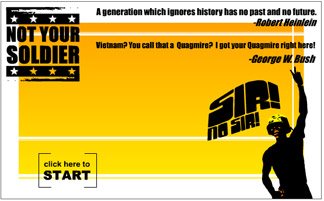
In collaboration with the Not Your Soldier project, Sir! No Sir! just produced a *hot* new flash animation which you can check out here. The idea was to bridge the film release with whats going on right now in Iraq and come out with something that organizers could use as a counter-recruitment tool, specifically with the younger cats out there who are getting targeted pretty hard at high schools across the country. Speaking of counter-recruitment work, the War Resisters League just released this "counter recruitment 101" guide called the DMZ. If you know anyone either doing this kind of work, anyone interested in this kind of work, or anyone at a high school or college campus getting targeted by recruiters tell them to check that out.

Wednesday, May 24, 2006

Rebirth... Blog launch 2.0

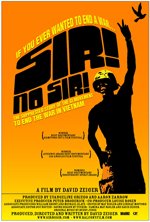
So after only really posting once every few weeks, im ready to give this thing another shot. There has been so much going on these past few months i dont even really know where to start... well I guess the main project i have been working on as of late has been this film Sir! No Sir! which i got hired to promote when it came here to New York and then stayed on to help with a few more cities including Washington DC where its playing right now.

Working on the film has been a great experience, besides finally gettin' paid for something after finishing up my run on unemployment i got to plug back into anti-war organizing during a pretty crucial time. Since the film documents the resistance inside the US military during the Vietnam war, a lot of our outreach work centered on veteran groups across the country including the recently formed Iraq Veterans Against the War [IVAW], Veterans for Peace [VFP], and Vietnam Veterans Agains the War [VVAW].

Im gonna try and post a bunch of content over the next few days and get back in the groove of doing this blog thing...

Monday, April 17, 2006


Left Turn Magazine #20 Out Now!

After months of hard work, our 5-year anniversary issue is finally out and those of you who are subscribers should be getting it in the mail any day now. Below im attaching a copy of our special anniversary editorial which we worked on for a while are are pretty excited about. You can also read it online on our website.

The editorial is kind of a culmination of the discussions that many of us involved with the magazine have been having for the past few years. People who are familiar with Left Turn know that we dont really 'editorialize' too much, preferring to allow others write and reflect on their work. For this anniversary issue we decided to try and write something up that gave people a sense of what we are thinking about and how we see the magazine contributing to the larger struggle for social change.

Also we are doing a series of anniversary events around the country including two here in New York (April 18th at the Brecht Forum, and April 26th at Bluestockings books.) On April 21st we will be doing an event up at UMASS and later in May we will be making stops in Philly, Baltimore, and DC. On the West Coast there will also be a big event on May 4th. If anyone wants more info on these or future events, feel free to email me at: max@riseup.net


Notes from the Global Intifada: 5-Year Anniversary Editorial
by Left Turn

Over the past five years, Left Turn magazine has become a resource for many organizers and activists through our in-depth news coverage of politics, media, and social movements in the US and globally. In all of our work, we have strived to project a non-sectarian, non-dogmatic, radical critique of corporate globalization and imperialism and shine a focus on concrete alternatives. But perhaps what makes Left Turn unique from much of the other alternative media is that at the core, Left Turn is a political project.

The magazine serves as a movement publication, working to reflect and support the grassroots. By playing this role, it has attempted to connect key pieces of the vibrant yet still very fractured radical movements here in the US. Left Turn believes in the importance of giving voice and space to those who are active in struggles for justice and self-determination, rather than those who merely comment on them from afar. Therefore, our writers are often those who have been shut out of mainstream printed political discussions—youth, grassroots voices, and those most affected by the systems of oppression against which they fight.

By encouraging these new authors to write and reflect on their experiences, Left Turn supports a new and diverse generation of activists. While unpaid, these writers are themselves invested in this political project, and have found the magazine to be a helpful resource in their own local organizing. Maintaining these mutually supportive relationships between our collective and writers and activists from multiple movements is what makes us thrive.

US context

Although we take inspiration and give extensive coverage to social movements all over the world, we take the words of the Zapatistas seriously when they ask us to “be a Zapatista in your community, be a rebel where you are.” Therefore, we place ourselves within the struggle for revolutionary change in the US, the heart of the global empire.

Working for radical social justice in the United States can seem like a cruel paradox. At the epicenter of power and privilege, we are located in a place and period in time where our actions (or lack thereof) as activists and organizers carry a huge amount of influence across the world. Yet, we have not been immune to the effects of neoliberalism and corporate globalization.

We have been especially hard-hit by the barrage of corporate media institutions that seek to impose a “philosophy of futility” on us—discouraging collective social action. We have witnessed the attacks on the social safety net over the past 25 years, part of a larger rollback of many of the gains won by the social movements in previous decades. It is important to remember that those social movements were systematically disrupted and crushed through a combination of COINTELPRO and mass incarceration of black and brown activists and communities. With this, we have experienced a serious break down in social relationships as families have been torn apart by the criminalization and incarceration of a generation.

The power and vision of organized labor has been at an all-time low, making it hard for the majority of working people to collectively press for even the most basic rights. Working people are putting in longer hours for less pay with fewer benefits. This has led to the creation of a large, flexible, and often timid “precarious workforce.”

Youth seeking to work for progressive or radical change now often turn to NGOs and the larger ‘Non-Profit Industrial Complex’ for work. One of the key problems with the predominance of these types of organizations, even those with more radical visions, is that they make for a highly fractionalized movement with organizational goals often tied to the agenda of their liberal funders. This inevitably creates a barrier to building movement strategies that span multiple issues and have larger systemic analysis.

Cracks in the empire

In 1999, we witnessed a crack in the empire. Inspired by the Zapatista uprising and other movements against neoliberalism, tens of thousands swarmed the World Trade Organization meetings in Seattle and forever altered the discourse on free trade and corporate globalization. Suddenly the impossible seemed possible, ushering in a new generation of anti-capitalist activism in North America.

Following September 11, 2001, and the (reformulated) “war on terror,” many of these movements have fallen under serious attack, and activists have had to re-orient themselves. Fear mongering and repression in the post-9/11 environment has been used by the state not only to come down on Arabs and Muslims, but on all people of color, immigrants, and radicals.

In the face of the “new imperialism,” showcased by the invasion of Afghanistan and Iraq, many activists in the US have seen the need to shift energies to building up a broad-based anti-war movement. This movement has been marked by an impressive series of large demonstrations over the past four years, including the historic Feb 15, 2003 protests around the world. Still, without having articulated a long-term strategy beyond the street protests, the anti-war movement has yet to develop the sustained involvement of a broader cross-section of the public in large enough numbers—something that will continue to be a problem as the Bush administration steps up its aggressive rhetoric towards Iran.

Left Turn was born from the hopeful energy in the streets of Seattle, but matured in “the age of terrorism.” We have strived to preserve the spirit of the slogan “Another World is Possible,” while working tirelessly to combat the misinformation and racist logic of US empire. We have tried to give political and historical context to the Middle East, both to counter the distorted picture painted by the corporate media as well as the simplistic analyses within segments of the Left.

To this end, we have highlighted progressive political forces within the Arab and Muslim world, and shown how US and Western intervention has consistently worked against those forces. It is crucial for activists in the US to understand the complexities of the region, specifically the fact that fundamentalist forces in the Middle East—whether Muslim, Jewish, or Christian—are in no way inevitable in that region, but have historically been nurtured and supported by Western governments.

The Palestinian struggle for freedom and self-determination, an issue that has historically divided the progressive movement here in the US, has been central to our analysis of the Middle East. The Israeli occupation of Palestine, supported and funded by the US, is key to understanding the role of the Western powers in maintaining hegemony over the region. An important aspect of Left Turn’s work has been to create a space for the voices of Palestinian grassroots activists and their allies in the Palestine Solidarity Movement—a movement under attack from both the right wing and internal sectarianism.

Revolution

There are many challenges facing the left in the US today. In order for us to move forward, it is important to have a sober assessment of the political terrain. It is equally important, however, that we do not fall into the trap of defeatism and demobilization. We do not need to put our hopes into the lesser of two evil political parties, and we do not need to compromise our larger vision for a series of short-term reforms. As Robin D.G. Kelley writes, “we still need freedom dreams.” We still need revolution.

What this revolution would look like is still far from clear. Like many of today’s social movements around the globe, we have rejected both the notion of the vanguard party structure as a means to liberate ourselves, as well as the path of social democracy and electoral politics. There is indeed no paved road to revolution, but many unbeaten trails that we have yet to walk.

Past attempts at revolution have shown us that true freedom and liberation cannot be imposed nor granted from above. They must grow from grassroots organizations of people controlling and running their own communities, schools, workplaces, and lives. Therefore, we at Left Turn, like much of the global justice movements, commit ourselves to democratic and non-hierarchical organizing as a core building block for any truly radical change.

Hope in the dark

Finally, we wish to project a politics of hope, inspiration, and solidarity based on both the rich history of social movements and the visionary work of everyday people coming together to radically transform society. We live in dark times, but it is important to remember that we have the power to chart another course. There is widespread resentment of the Bush administration and the larger political establishment that we can build on in the coming months. The government’s criminal response to Hurricane Katrina domestically and the ongoing disastrous occupation of Iraq abroad has made ruling class priorities quite clear to millions of people.

The challenge for us is not simply to keep pointing out how bad everything is for people. We have to be capable of building movements that those people actually want to be a part of and feel like they can help shape. For our part, we will continue to provide forums for cross-movement dialogue, debate, and analysis. We hope that over the yearsLeft Turn will continue to be a resource to this “movement of movements,” reflecting and encouraging relevant revolutionary politics and visions in the struggle for a better world.


In Struggle,
The Left Turn editorial collective


Wednesday, April 05, 2006

"Sir, No Sir!" Anti-War Documentary!

The groundbreaking new anti-war documentary "Sir, No Sir" just opened out in California, and is coming to New York City from April 19-26th with two special benefit screenings featuring Jane Fonda on April 17th.

Besides documenting an important piece of anti-war history, people should try and go see this film during its opening run because if it does well in New York City it is ready to go nation-wide to over 30 cities. It will be important for people outside of the coastal cities to be able to check this film out at their local theatre, and that will only happen if it does well in New York... So get a group of friends together and plan an evening at the movies, every ticket counts!

Friday, March 24, 2006


Washington's Wars and Occupations: Month in Review #11


March 23, 2006 By Max Elbaum, War Times/Tiempo de Guerras


BUSH ESCALATES IRAQ VIOLENCE AND THREATENS MORE WARS

On the third anniversary of the Iraq invasion, George Bush's Iraq policy is less
popular than ever before. The latest Newsweek poll shows approval at only 29%, compared
to 65% opposition. A first-ever poll of U.S. troops in Iraq shows 72% think the
U.S. should get out within the next year. Even conservatives and experts who once
backed Bush's war are jumping ship: the latest important defection came March 10
when New York Times reporter John Burns, back from another long period in Baghdad,
said he felt, for the first time, "that the American effort in Iraq will likely
fail."

Internationally, the administration is isolated. Members of the "Coalition
of the Willing" are one by one withdrawing from Iraq. Popular anger at the
U.S. is at record levels in the Middle East and across the globe.

Under the circumstances, one might guess that Washington would be looking for a
way to retrench. Conservative hawks like William F. Buckley, concerned about minimizing
the damage to U.S. imperial power, advise precisely that course: "The administration
has to cope with failure," Buckley writes. "Different plans must be made."

But Bush's response is: "Stay the Course - and More." The administration
is digging in to stay in Iraq indefinitely. It is escalating the use of violence.
It is threatening new military adventures and bullying from Iran to Venezuela to
Palestine.

NO PULLOUT, NO LETUP

Speaking to the press March 21, Bush made it absolutely clear there will be no pullout
from Iraq while he is President. Asked directly whether there would come a day when
no U.S. forces are in Iraq, he responded, ''That will be decided by future presidents
and future governments of Iraq.''

Less than a week earlier, General John Abizaid, U.S. commander in Iraq, sent the
same message. The U.S. "may want to keep a long-term military presence in Iraq
to bolster moderates against extremists in the region and protect oil supplies,"
Abizaid declared. Asked if this meant keeping permanent military bases in Iraq,
the general said he "could not rule that out." Two-weeks later, Abizaid
was rewarded with an extension of his tenure, making him the longest serving commander
in the history of the U.S. Central Command.

Meanwhile U.S. forces are escalating, not reducing, their use of violence. According
to an investigation published by Knight Ridder newspapers March 14: "A review
of military data shows that daily bombing runs and jet-missile launches have increased
by more than 50% in the past five months, compared with the same period last year.
Knight Ridder's findings were confirmed by Air Force officials in the region...

"The numbers also show that U.S. forces dropped bombs on more cities during
the last five months than they did during the same period a year ago... Stories
of American missiles hitting the homes of innocents are passed between Iraqi men
at teahouses and during Friday worship services. 'Residents worry that their homes
will be bombed at any time,' said Hussein Ali Jaafar, who owns a stationery shop
in the town of Balad, north of Baghdad, which was targeted by bombs or missiles
at least 27 times between October 2005 and February 2006. 'Most of the bombing is
unjustified and random. It does not differentiate between militants and innocent
people.'"

OCCUPATION FUELS SECTARIAN CONFLICT

These escalating U.S. tactics will fuel - not reduce - the deadly sectarian conflict
raging between Sunni and Shia armed groups. A must-read analysis by Michael Schwartz
at http://www.tomdispatch.com describes the ways U.S. policy has fostered sectarian
violence and makes the crucial point - not discussed in the U.S. media - that the
overwhelming bulk of armed attacks (80% on average) are against the U.S. military
and its Coalition allies, not against Iraqi civilians. The killing of civilians
by both Shiite and Sunni sectarian groups and militias is real and terrible, but
it is now being trumpeted by U.S. authorities as a justification for continuing
the U.S. occupation instead of being acknowledged as in large part a result of U.S.
occupation policies. Schwartz writes:

"All the conflicts of the present moment have metastasized and spread from
the ill-fated attempt by American-led forces to pacify Sunni communities... Today,
not only is the country edging toward an ever-more virulent civil war, but the Sunni
resistance is stronger than ever, registering about 100 attacks a day in January...

"This original war remains the central front in the ongoing battle for domination
in Iraq and it continues to cast off enough bitterness, suffering, destruction,
and rebellion to guarantee its never-ending spread to new areas and groups... If
the Americans sought to establish the legitimacy of the occupation by crushing early
signs of Sunni resistance, that effort has, in the end, only helped convince Iraqis
of the illegitimacy of the American presence. For all its failures, however, the
occupation has succeeded in one endeavor. It has managed to undermine all efforts
by other parties to establish their own legitimacy and therefore to build a foundation
for a new and sovereign Iraq. If one day Iraq ceases to be, splitting chaotically
into several entities, the way the occupation destroyed sovereignty (along with
parts of Sunni cities) will certainly come in for a major share of the blame."

PRE-EMPTIVE WAR, EXPANDING TARGET LIST

And it isn't just Iraq. The administration's newest National Security Document
officially repeats the so-called Bush Doctrine, in which Washington claims the right to
launch a preemptive war whenever it believes another country "might" threaten
the U.S.

The document targeted Iran as the most likely candidate for preventive war treatment.
"We may face no greater challenge from a single country than from Iran,'' it
said. Administration officials are keeping up the drumbeat of threats against that
country, even though Iran's nuclear program complies with the Nuclear Non-Proliferation
Treaty which Tehran has signed. Meanwhile Israel and India - nuclear powers which
have not signed the treaty - get the go-ahead from Washington for their nuclear
programs.

In a particularly worrying development, the Los Angeles Times reported March 21
that "U.S. intelligence officials...citing evidence from highly classified
satellite feeds and electronic eavesdropping, believe the Iranian regime is playing
host to much of Al Qaeda's remaining brain trust and allowing the senior operatives
freedom to communicate and help plan the terrorist network's operations. And they
suggest that recently elected President Mahmoud Ahmadinejad may be forging an alliance
with Al Qaeda operatives...The accusations echo charges that Bush administration
figures made about Iraq in the run-up to the U.S.-led invasion three years ago."

Of course Iran-Al Qaeda ties make little sense, since Al Qaeda is central to the
killing of Iraqi Shiites friendly to Iran and has denounced all Shiites, including
the Iranian leadership, as infidels. But the Bush administration did not let facts
get in the way of its previous war drive. There is no reason to expect more scruples
from them today.

Administration officials are also carrying over their demonization of Iran to
Venezuela. Secretary of State Condoleezza Rice told Congress last month that the U.S.
was using an "inoculation strategy" against alleged meddling by Venezuelan leader
Hugo Chavez. Rice called Venezuela a "sidekick" of Iran and the administration
upgraded their official assessment of Chavez' government as a "security threat."

BLANK CHECK FOR ISRAEL

Bush is also giving a huge blank check to Israel in its effort to forcibly impose
an illegal and unjust "solution" on the Israeli-Palestinian conflict.
On March 14 Israel brazenly violated an agreement it had signed (guaranteed by the
U.S. and Britain) by raiding a Palestinian prison in Jericho and seizing a number
of prisoners. Polls showed that even half the Israeli population believed the attack
was in part an electoral gimmick. The other part was a signal to the Palestinians
that the Israeli military will do what it pleases and that it has U.S. and British
support. Israeli peace activist Uri Avnery bluntly said:

"For a politician to send the army in to collect votes is an abhorrent act.
In this action, three people were killed. Many more lives, Palestinian and Israeli,
were put at risk....This is not the first time for [acting Prime Minister] Ehud
Olmert to walk over dead bodies on his way to power. As mayor of Jerusalem, he pushed
for the opening of a tunnel in the area of the Muslim shrines, causing (as expected)
dozens of casualties."

Despite Washington guaranteeing the Jericho prison agreement, the White House did
not utter a word of protest at the Israeli action. Nor did the Bush administration
object when Olmert openly discarded Bush's own "road map" for peace and
announced plans to unilaterally set Israel's borders with a huge annexation of
Palestinian land by 2010, using the route of the so-called "security fence" as his
guideline.

Israel's propaganda justification for such actions is the claim that it has "no
partner for peace." But even former U.S. President Jimmy Carter cut through
to the heart of the matter in a March 9 opinion piece, writing that "The preeminent
obstacle to peace is Israel's colonization of Palestine."

LATEST TORTURE REVELATION: "NO BLOOD, NO FOUL"

The New York Times reported March 19 under the headline "Before and After Abu
Ghraib, a U.S. Unit Abused Detainees":

"...in early 2004 an elite Special Operations forces unit converted one of
Saddam Hussein's former military bases into a top-secret detention center. American
soldiers made one of the former Iraqi government's torture chambers into their own
interrogation cell. They named it the Black Room. In the windowless, jet-black
garage-size room, some soldiers beat prisoners with rifle butts, yelled and spit in their
faces and, in a nearby area, used detainees for target practice in a game of jailer
paintball...Placards posted by soldiers at the detention area advised,
"NO BLOOD, NO FOUL." The slogan reflected an adage adopted by Task Force 6-26:
'If you don't make them bleed, they can't prosecute for it'... 'The reality is, there were no rules there,'
a Pentagon official said."

ALL OUT APRIL 29 & URGENT DEFENSE OF IMMIGRANT RIGHTS

Protest and mass pressure against all this is urgent. The next big moment for the
antiwar movement will be the March for Peace, Justice and Democracy in New York
City April 29, initiated by United for Peace and Justice, Rainbow/PUSH Coalition,
National Organization for Women, Friends of the Earth, U.S. Labor Against the War,
Climate Crisis Coalition, Peoples' Hurricane Relief Fund, National Youth and Student
Peace Coalition and Veterans For Peace. Go to http://www.april29.org for full
information.

The April 29 action includes a vital call to defend immigrant rights. New vicious
anti-immigrant legislation may be up for a vote in Congress next week. Contact the
National Network for Immigrant and Refugee Rights for background and action
information: http://www.nnirr.org or go to http://www.immigrantrights.org


War Times/Tiempo de Guerras is an all-volunteer project fiscally sponsored by the
Center for Third World Organizing. Donations to War Times are tax-deductible; you
can donate on-line at http://www.war-times.org or send a check to War Times/Tiempo
de Guerras, c/o P.O. Box 99096, Emeryville, CA 94662.